


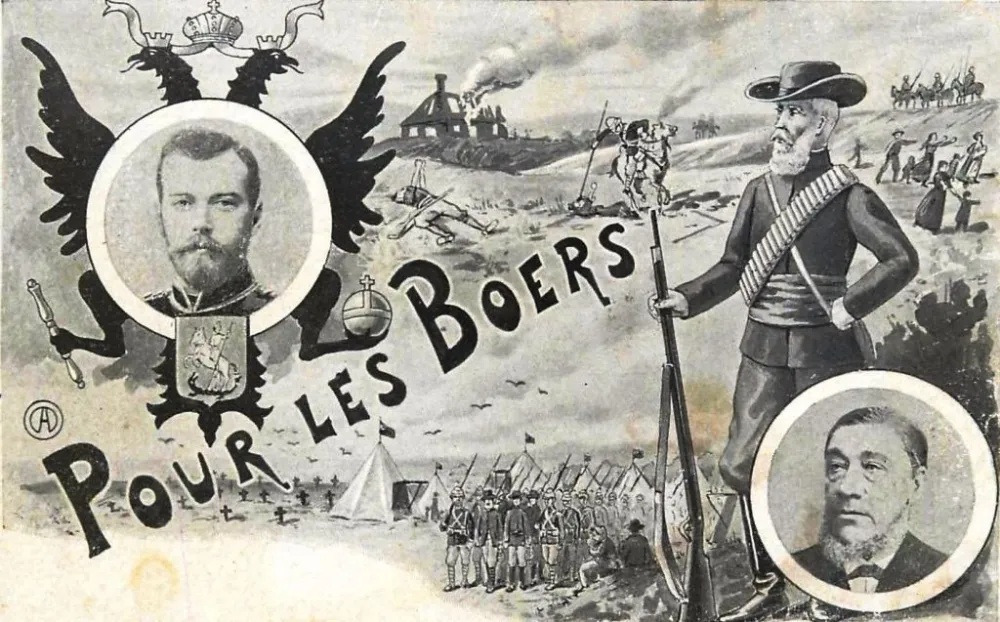
Russia’s involvement in the Anglo-Boer War (1899–1902) was limited, primarily diplomatic and symbolic, with no direct military intervention. Here’s a concise summary:
No Official Military Aid: Despite Boer hopes for Russian or European intervention, Russia provided no weapons, funds, or troops, as it prioritized its own strategic interests, including the Russo-Japanese War looming in 1904–1905.
Diplomatic Support: The Russian Empire, under Tsar Nicholas II, expressed sympathy for the Boer cause, viewing it as a struggle against British imperialism. This aligned with Russia’s geopolitical rivalry with Britain, particularly in the context of the “Great Game” in Central Asia.
Public Sentiment: Russian public opinion, fueled by Pan-Slavic and anti-imperialist sentiments, was largely pro-Boer. Newspapers and intellectuals romanticized the Boers as freedom fighters resisting British oppression.
Volunteer Efforts: A small number of Russian volunteers, estimated at fewer than 50, traveled to South Africa to fight alongside the Boers. Notable figures included:
Yevgeny Maximov, a Russian officer who joined Boer forces and later wrote about his experiences.
Alexander Guchkov, a future Russian politician, who also fought briefly with the Boers.
These volunteers had negligible military impact but symbolized Russian solidarity.
Medical Support: Russia sent a Red Cross medical unit, funded partly by public donations, to assist Boer civilians and fighters. This included doctors and nurses who worked in Boer hospitals.
International Context: Russia, alongside other European powers like Germany and France, criticized Britain’s conduct, particularly the concentration camps. However, Russia’s involvement remained cautious due to its own internal issues (e.g., economic strain, pre-revolutionary unrest) and reluctance to escalate tensions with Britain.